

How Do Bone Cells Repair Breaks In The Bone
Os
Bones are made of a combination of meaty bone tissue for strength and spongy bone tissue for compression in response to stresses.
Learning Objectives
Distinguish between compact and spongy os tissues
Fundamental Takeaways
Key Points
- Compact bone is the hard external layer of all bones that protects, strengthens, and surrounds the medullary cavity filled with marrow.
- Cylindrical structures, called osteons, are aligned forth lines of the greatest stress to the bone in gild to resist bending or fracturing.
- Spongy or cancellous bone tissue consists of trabeculae that are arranged equally rods or plates with red bone marrow in between.
- Spongy os is prominent in regions where the bone is less dense and at the ends of long basic where the bone has to exist more compressible due to stresses that arrive from many directions.
Key Terms
- trabecula: a small-scale mineralized spicule that forms a network in spongy os
- epiphysis: the rounded finish of whatever long bone
- osteocyte: a mature bone cell involved with the maintenance of os
- osteon: any of the primal canals and surrounding bony layers found in meaty os
Os Tissue
Bones are considered organs because they comprise various types of tissue, such every bit claret, connective tissue, nerves, and bone tissue. Osteocytes, the living cells of bone tissue, course the mineral matrix of basic. There are 2 types of bone tissue: compact and spongy.
Compact Bone Tissue
Compact bone (or cortical bone), forming the hard external layer of all bones, surrounds the medullary cavity (innermost part or bone marrow). Information technology provides protection and strength to bones. Meaty os tissue consists of units chosen osteons or Haversian systems. Osteons are cylindrical structures that contain a mineral matrix and living osteocytes continued past canaliculi which transport claret. They are aligned parallel to the long axis of the bone. Each osteon consists of lamellae, layers of meaty matrix that environs a fundamental canal (the Haversian or osteonic culvert), which contains the os's blood vessels and nerve fibers. Osteons in compact bone tissue are aligned in the same management along lines of stress, helping the bone resist bending or fracturing. Therefore, compact bone tissue is prominent in areas of bone at which stresses are practical in only a few directions.

Components of compact bone tissue: Compact os tissue consists of osteons that are aligned parallel to the long axis of the bone and the Haversian canal that contains the os's claret vessels and nerve fibers. The inner layer of bones consists of spongy os tissue. The small dark ovals in the osteon represent the living osteocytes.
Spongy Bone Tissue
Compact bone tissue forms the outer layer of all bones while spongy or cancellous bone forms the inner layer of all bones. Spongy os tissue does not contain osteons. Instead, information technology consists of trabeculae, which are lamellae that are arranged every bit rods or plates. Cerise os marrow is establish between the trabuculae. Blood vessels within this tissue deliver nutrients to osteocytes and remove waste. The red os marrow of the femur and the interior of other large bones, such as the ileum, forms blood cells.

Arrangement of trabeculae in spongy os: Trabeculae in spongy bone are arranged such that i side of the os bears tension and the other withstands pinch.
Spongy os reduces the density of bone, allowing the ends of long basic to shrink as the effect of stresses applied to the os. Spongy bone is prominent in areas of bones that are not heavily stressed or where stresses arrive from many directions. The epiphysis of a os, such as the cervix of the femur, is subject to stress from many directions. Imagine laying a heavy-framed picture flat on the flooring. You could hold up ane side of the moving-picture show with a toothpick if the toothpick were perpendicular to the floor and the motion picture. At present, drill a hole and stick the toothpick into the wall to hang up the picture. In this example, the part of the toothpick is to transmit the downward pressure of the picture to the wall. The forcefulness on the picture is straight downwardly to the flooring, merely the strength on the toothpick is both the motion picture wire pulling down and the bottom of the hole in the wall pushing upwardly. The toothpick will break off correct at the wall.
The neck of the femur is horizontal like the toothpick in the wall. The weight of the body pushes it down near the articulation, but the vertical diaphysis of the femur pushes information technology upwards at the other stop. The cervix of the femur must exist strong enough to transfer the downward strength of the body weight horizontally to the vertical shaft of the femur.
Prison cell Types in Bones
The osteoblast, osteoclast, osteocyte, and osteoprogenitor bone cells are responsible for the growing, shaping, and maintenance of basic.
Learning Objectives
Distinguish amid the four jail cell types in bone
Key Takeaways
Fundamental Points
- Osteogenic cells are the but bone cells that divide.
- Osteogenic cells differentiate and develop into osteoblasts which, in turn, are responsible for forming new basic.
- Osteoblasts synthesize and secrete a collagen matrix and calcium salts.
- When the surface area surrounding an osteoblast calcifies, the osteoblast becomes trapped and transforms into an osteocyte, the nigh common and mature type of os prison cell.
- Osteoclasts, the cells that break down and reabsorb bone, stem from monocytes and macrophages rather than osteogenic cells..
- There is a continual residual betwixt osteoblasts generating new bone and osteoclasts breaking down bone.
Primal Terms
- osteoclast: a big multinuclear jail cell associated with the resorption of bone
- osteocyte: a mature bone prison cell involved with the maintenance of bone
- osteoprogenitor: a stem cell that is the precursor of an osteoblast
- canaliculus: any of many pocket-size canals or ducts in bone or in some plants
- periosteum: a membrane surrounding a os
- endosteum: a bleary vascular layer of cells which line the medullary cavity of a bone
- lacuna: a pocket-size opening; a modest pit or depression; a small bare infinite; a gap or vacancy; a hiatus
- osteoblast: a mononucleate cell from which bone develops
Cell Types in Bones
Bone consists of four types of cells: osteoblasts, osteoclasts, osteocytes, and osteoprogenitor (or osteogenic) cells. Each cell blazon has a unique part and is found in unlike locations in bones. The osteoblast, the bone cell responsible for forming new bone, is found in the growing portions of os, including the periosteum and endosteum. Osteoblasts, which practice not carve up, synthesize and secrete the collagen matrix and calcium salts. As the secreted matrix surrounding the osteoblast calcifies, the osteoblast becomes trapped within information technology. As a event, it changes in structure, becoming an osteocyte, the primary jail cell of mature bone and the near mutual type of bone cell. Each osteocyte is located in a infinite (lacuna) surrounded by bone tissue. Osteocytes maintain the mineral concentration of the matrix via the secretion of enzymes. As is the case with osteoblasts, osteocytes lack mitotic activity. They are able to communicate with each other and receive nutrients via long cytoplasmic processes that extend through canaliculi (singular = canaliculus), channels inside the bone matrix.

Os cell types: Table listing the function and location of the four types of bone cells.

4 types of os cells: Four types of cells are found within bone tissue. Osteogenic cells are undifferentiated and develop into osteoblasts. When osteoblasts get trapped inside the calcified matrix, their structure and function changes; they get osteocytes. Osteoclasts develop from monocytes and macrophages and differ in advent from other bone cells.
If osteoblasts and osteocytes are incapable of mitosis, then how are they replenished when one-time ones dice? The answer lies in the properties of a tertiary category of bone cells: the osteogenic cell. These osteogenic cells are undifferentiated with high mitotic activity; they are the merely bone cells that divide. Immature osteogenic cells are found in the deep layers of the periosteum and the marrow. When they differentiate, they develop into osteoblasts. The dynamic nature of os means that new tissue is constantly formed, while old, injured, or unnecessary bone is dissolved for repair or for calcium release. The jail cell responsible for bone resorption, or breakup, is the osteoclast, which is found on bone surfaces, is multinucleated, and originates from monocytes and macrophages (two types of white blood cells) rather than from osteogenic cells. Osteoclasts continually break down old bone while osteoblasts continually course new bone. The ongoing residual betwixt osteoblasts and osteoclasts is responsible for the abiding, just subtle, reshaping of bone.
Bone Evolution
Intramembranous ossification stems from fibrous membranes in flat bones, while endochondral ossification stems from long bone cartilage.
Learning Objectives
Distinguish between intramembranous and endochondral ossification
Key Takeaways
Key Points
- The ossification of the apartment basic of the skull, the mandible, and the clavicles begins with mesenchymal cells, which then differentiate into calcium-secreting and bone matrix-secreting osteoblasts.
- Osteoids form spongy bone around blood vessels, which is subsequently remodeled into a thin layer of compact bone.
- During enchondral ossification, the cartilage template in long bones is calcified; dying chondrocytes provide space for the evolution of spongy bone and the bone marrow cavity in the interior of the long basic.
- The periosteum, an irregular connective tissue effectually bones, aids in the attachment of tissues, tendons, and ligaments to the bone.
- Until boyhood, lengthwise long bone growth occurs in secondary ossification centers at the epiphyseal plates (growth plates) near the ends of the bones.
Key Terms
- osteoid: an organic matrix of poly peptide and polysaccharides, secreted by osteoblasts, that becomes bone after mineralization
- endochondral: inside cartilage
- chondrocyte: a cell that makes up the tissue of cartilage
- diaphysis: the central shaft of whatever long os
Development of Bone
Ossification, or osteogenesis, is the process of bone germination past osteoblasts. Ossification is distinct from the process of calcification; whereas calcification takes place during the ossification of bones, information technology can also occur in other tissues. Ossification begins approximately half-dozen weeks after fertilization in an embryo. Earlier this time, the embryonic skeleton consists entirely of fibrous membranes and hyaline cartilage. The development of bone from fibrous membranes is called intramembranous ossification; development from hyaline cartilage is called endochondral ossification. Os growth continues until approximately historic period 25. Bones tin grow in thickness throughout life, simply after historic period 25, ossification functions primarily in bone remodeling and repair.
Intramembranous Ossification
Intramembranous ossification is the procedure of bone development from fibrous membranes. It is involved in the formation of the flat bones of the skull, the mandible, and the clavicles. Ossification begins every bit mesenchymal cells grade a template of the hereafter bone. They then differentiate into osteoblasts at the ossification center. Osteoblasts secrete the extracellular matrix and deposit calcium, which hardens the matrix. The non-mineralized portion of the os or osteoid continues to form around blood vessels, forming spongy bone. Connective tissue in the matrix differentiates into red bone marrow in the fetus. The spongy bone is remodeled into a thin layer of compact bone on the surface of the spongy bone.
Endochondral Ossification
Endochondral ossification is the process of bone development from hyaline cartilage. All of the bones of the torso, except for the apartment bones of the skull, mandible, and clavicles, are formed through endochondral ossification.

Process of endochondral ossification: Endochondral ossification is the process of bone development from hyaline cartilage. The periosteum is the connective tissue on the outside of bone that acts equally the interface betwixt os, blood vessels, tendons, and ligaments.
In long bones, chondrocytes form a template of the hyaline cartilage diaphysis. Responding to complex developmental signals, the matrix begins to calcify. This calcification prevents diffusion of nutrients into the matrix, resulting in chondrocytes dying and the opening up of cavities in the diaphysis cartilage. Blood vessels invade the cavities, while osteoblasts and osteoclasts alter the calcified cartilage matrix into spongy os. Osteoclasts so break downwards some of the spongy bone to create a marrow, or medullary cavity, in the center of the diaphysis. Dense, irregular connective tissue forms a sheath (periosteum) around the bones. The periosteum assists in attaching the bone to surrounding tissues, tendons, and ligaments. The os continues to grow and elongate every bit the cartilage cells at the epiphyses divide.
In the terminal stage of prenatal bone development, the centers of the epiphyses begin to calcify. Secondary ossification centers form in the epiphyses as claret vessels and osteoblasts enter these areas and convert hyaline cartilage into spongy os. Until adolescence, hyaline cartilage persists at the epiphyseal plate (growth plate), which is the region between the diaphysis and epiphysis that is responsible for the lengthwise growth of long bones.
Growth of Os
Long bones lengthen at the epiphyseal plate with the improver of os tissue and increase in width by a process called appositional growth.
Learning Objectives
Draw the processes of post-fetal bone growth and bone thickening
Key Takeaways
Fundamental Points
- The epiphyseal plate, the expanse of growth composed of four zones, is where cartilage is formed on the epiphyseal side while cartilage is ossified on the diaphyseal side, thereby lengthening the bone.
- Each of the iv zones has a function in the proliferation, maturation, and calcification of os cells that are added to the diaphysis.
- The longitudinal growth of long basic continues until early on adulthood at which time the chondrocytes in the epiphyseal plate stop proliferating and the epiphyseal plate transforms into the epiphyseal line as bone replaces the cartilage.
- Bones can increase in diameter even afterward longitudinal growth has stopped.
- Appositional growth is the process past which erstwhile bone that lines the medullary crenel is reabsorbed and new bone tissue is grown beneath the periosteum, increasing bone diameter.
Key Terms
- metaphysis: the role of a long os that grows during development
- periosteum: a membrane surrounding a bone
- ossification: the normal process by which os is formed
- chondrocyte: a prison cell that makes upwardly the tissue of cartilage
- hypertrophy: to increment in size
- diaphysis: the central shaft of any long os
- epiphysis: the rounded end of any long bone
- medullary: pertaining to, consisting of, or resembling, marrow or medulla
Growth of Os
Long basic continue to lengthen (potentially throughout boyhood) through the add-on of bone tissue at the epiphyseal plate. They also increase in width through appositional growth.
Lengthening of Long Bones
The epiphyseal plate is the surface area of growth in a long bone. It is a layer of hyaline cartilage where ossification occurs in immature basic. On the epiphyseal side of the epiphyseal plate, cartilage is formed. On the diaphyseal side, cartilage is ossified, allowing the diaphysis to grow in length. The metaphysis is the wide portion of a long os between the epiphysis and the narrow diaphysis. It is considered a function of the growth plate: the function of the bone that grows during childhood, which, as information technology grows, ossifies near the diaphysis and the epiphyses.
The epiphyseal plate is composed of four zones of cells and activity.
- The reserve zone, the region closest to the epiphyseal end of the plate, contains small chondrocytes within the matrix. These chondrocytes exercise not participate in bone growth; instead, they secure the epiphyseal plate to the osseous tissue of the epiphysis.
- The proliferative zone, the adjacent layer toward the diaphysis, contains stacks of slightly-larger chondrocytes. It continually makes new chondrocytes via mitosis.
- The zone of maturation and hypertrophy contains chondrocytes that are older and larger than those in the proliferative zone. The more mature cells are situated closer to the diaphyseal end of the plate. In this zone, lipids, glycogen, and alkaline phosphatase accrue, causing the cartilaginous matrix to lapidify. The longitudinal growth of bone is a result of cellular division in the proliferative zone forth with the maturation of cells in the zone of maturation and hypertrophy.
- The zone of calcified matrix, the zone closest to the diaphysis, contains chondrocytes that are dead because the matrix around them has calcified. Capillaries and osteoblasts from the diaphysis penetrate this zone. The osteoblasts secrete bone tissue on the remaining calcified cartilage. Thus, the zone of calcified matrix connects the epiphyseal plate to the diaphysis. A os grows in length when osseous tissue is added to the diaphysis.
After the zone of calcified matrix, there is the zone of ossification, which is actually office of the metaphysis. Arteries from the metaphysis branch through the newly-formed trabeculae in this zone. The newly-deposited bone tissue at the pinnacle of the zone of ossification is called the primary spongiosa. The older bone at the bottom of the zone of ossification is called the secondary spongiosa.

Longitudinal os growth: The epiphyseal plate is responsible for longitudinal bone growth. This analogy shows the zones adjoining the epiphyseal plate of the epiphysis. The topmost layer of the epiphysis is the reserve zone. The 2d zone, the proliferative zone, is where chondrocytes are continually undergoing mitosis. The next zone is the zone of maturation and hypertrophy where lipids, glycogen, and alkali metal phosphatase accumulate, causing the cartilaginous matrix to calcify. The following zone is the calcified matrix where the chondrocytes have hardened and die every bit the matrix effectually them has calcified. The bottom-well-nigh row is the zone of ossification which is function of the metaphysis. The newly-deposited bone tissue at the elevation of the zone of ossification is chosen the principal spongiosa, while the older bone is labeled the secondary spongiosa.
Bones continue to grow in length until early machismo with the rate of growth controlled past hormones. When the chondrocytes in the epiphyseal plate cease their proliferation and bone replaces the cartilage, longitudinal growth stops. All that remains of the epiphyseal plate is the epiphyseal line.
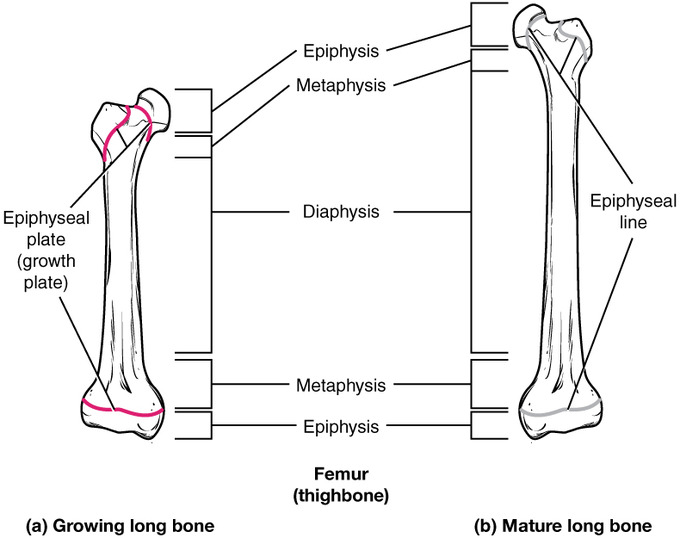
From epiphyseal plate to epiphyseal line: As a os matures, the epiphyseal plate progresses to an epiphyseal line. (a) Epiphyseal plates are visible in a growing os. (b) Epiphyseal lines are the remnants of epiphyseal plates in a mature os.
Thickening of Long Bones
While basic are increasing in length, they are likewise increasing in diameter; growth in diameter can keep even subsequently longitudinal growth ceases. This is called appositional growth. Osteoclasts, cells that piece of work to break downwardly bone, resorb onetime bone that lines the medullary cavity. At the same time, osteoblasts via intramembranous ossification, produce new bone tissue beneath the periosteum. The erosion of old bone forth the medullary cavity and the deposition of new bone beneath the periosteum not only increment the bore of the diaphysis, simply also increment the diameter of the medullary cavity. This procedure is called modeling.
Bone Remodeling and Repair
Bone is remodeled through the continual replacement of one-time os tissue, every bit well every bit repaired when fractured.
Learning Objectives
Outline the process of bone remodeling and repair
Cardinal Takeaways
Central Points
- Bone replacement involves the osteoclasts which break downward os and the osteoblasts which make new bone.
- Bone turnover rates differ depending on the bone and the expanse within the os.
- There are four stages in the repair of a broken bone: 1) the formation of hematoma at the break, 2) the germination of a fibrocartilaginous callus, three) the formation of a bony callus, and 4) remodeling and add-on of meaty bone.
- Proper os growth and maintenance requires many vitamins (D, C, and A), minerals (calcium, phosphorous, and magnesium), and hormones ( parathyroid hormone, growth hormone, and calcitonin ).
Key Terms
- callus: the material of repair in fractures of bone which is at first soft or cartilaginous in consistency, but is ultimately converted into true os and unites the fragments into a single piece
- spicule: a abrupt, needle-like slice
- fibroblast: a cell found in connective tissue that produces fibers, such as collagen
Bone Remodeling and Repair
Bone renewal continues afterward birth into adulthood. Os remodeling is the replacement of old bone tissue by new bone tissue. It involves the processes of os degradation or os product done past osteoblasts and bone resorption done by osteoclasts, which pause down old bone. Normal os growth requires vitamins D, C, and A, plus minerals such as calcium, phosphorous, and magnesium. Hormones such as parathyroid hormone, growth hormone, and calcitonin are besides required for proper bone growth and maintenance.
Bone turnover rates, the rates at which one-time bone is replaced by new os, are quite high, with five to 7 pct of bone mass being recycled every calendar week. Differences in turnover rates be in different areas of the skeleton and in unlike areas of a bone. For instance, the bone in the head of the femur may be fully replaced every six months, whereas the bone along the shaft is altered much more than slowly.
Os remodeling allows basic to conform to stresses by condign thicker and stronger when subjected to stress. Basic that are not discipline to normal everyday stress (for instance, when a limb is in a cast) will begin to lose mass.
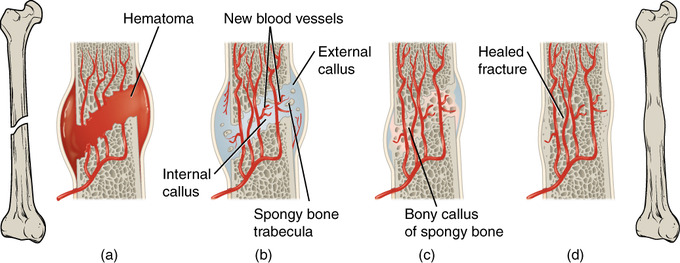
Stages of fracture repair: The healing of a bone fracture follows a serial of progressive steps: (a) A fracture hematoma forms. (b) Internal and external calli form. (c) Cartilage of the calli is replaced by trabecular bone. (d) Remodeling occurs.
A fractured or broken os undergoes repair through four stages:
- Hematoma germination: Blood vessels in the cleaved bone tear and hemorrhage, resulting in the formation of clotted blood, or a hematoma, at the site of the break. The severed blood vessels at the broken ends of the bone are sealed by the clotting process. Bone cells deprived of nutrients begin to die.
- Os generation: Within days of the fracture, capillaries abound into the hematoma, while phagocytic cells begin to articulate away the expressionless cells. Though fragments of the blood clot may remain, fibroblasts and osteoblasts enter the area and begin to reform bone. Fibroblasts produce collagen fibers that connect the broken bone ends, while osteoblasts start to class spongy bone. The repair tissue between the broken bone ends, the fibrocartilaginous callus, is composed of both hyaline and fibrocartilage. Some bone spicules may also appear at this signal.
- Bony callous germination: The fibrocartilaginous callus is converted into a bony callus of spongy bone. Information technology takes about 2 months for the broken bone ends to be firmly joined together subsequently the fracture. This is similar to the endochondral formation of bone when cartilage becomes ossified; osteoblasts, osteoclasts, and bone matrix are present.
- Bone remodeling: The bony callus is so remodelled by osteoclasts and osteoblasts, with excess material on the exterior of the os and inside the medullary crenel being removed. Compact bone is added to create os tissue that is similar to the original, unbroken bone. This remodeling can accept many months; the bone may remain uneven for years.

How Do Bone Cells Repair Breaks In The Bone,
Source: https://courses.lumenlearning.com/boundless-biology/chapter/bone/
Posted by: stapletonentin1953.blogspot.com
0 Response to "How Do Bone Cells Repair Breaks In The Bone"
Post a Comment